
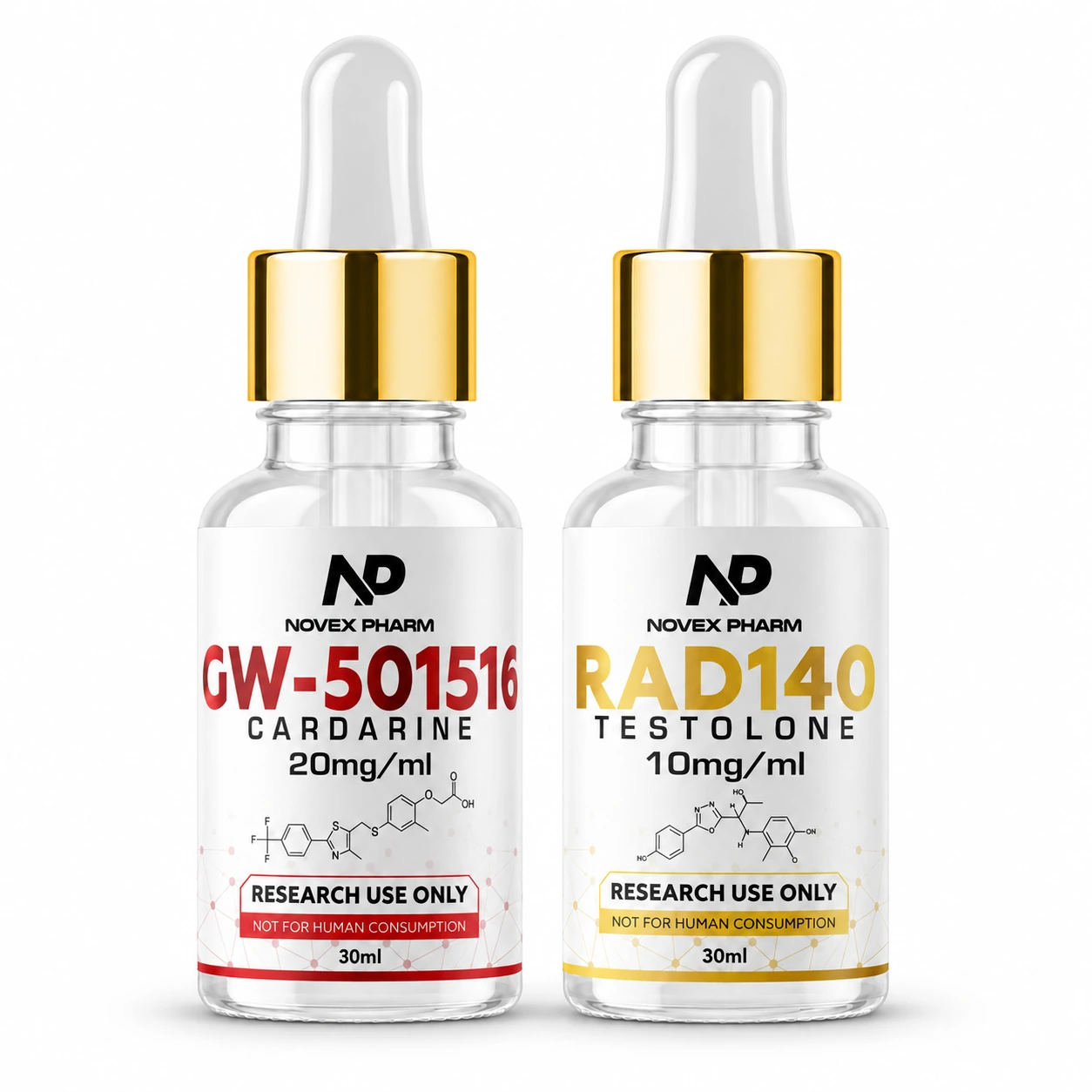
RAD-140 + GW-501516 Research Stack in Canada
This research stack contains RAD-140 (Testolone) and GW-501516 (Cardarine) as 2 separate, labelled liquid research solutions. The compounds are not premixed. The bundle is intended for laboratory identification, comparative documentation, and controlled research inventory; it is not a dietary supplement, medication, or product for human or veterinary use.
Stack specifications
| Compound | Listed concentration | Volume | Total listed compound | Documentation |
|---|---|---|---|---|
| RAD-140 (Testolone) | 10 mg/mL | 30 mL | 300 mg | See Testing & COA Documentation |
| GW-501516 (Cardarine) | 20 mg/mL | 30 mL | 600 mg | See Testing & COA Documentation |
Compare bottle and bundle contents
One stack contains 2 separate 30 mL bottles: RAD-140 (Testolone) 10 mg/mL; GW-501516 (Cardarine) 20 mg/mL. Choose the stack quantity above to see the total bottle count and current bundle price. Each compound stays in its own bottle; the contents are not premixed.
- MK-2866 (Ostarine) + GW-501516 (Cardarine) Research Stack: 2 separate 30 mL bottles (MK-2866 (Ostarine) 25 mg/mL; GW-501516 (Cardarine) 20 mg/mL).
- RAD-140 + LGD-4033 + GW-501516 (Cardarine) Research Stack: 3 separate 30 mL bottles (RAD-140 (Testolone) 10 mg/mL; LGD-4033 (Ligandrol) 10 mg/mL; GW-501516 (Cardarine) 20 mg/mL).
Compare by supplied contents and format. Catalogue bundles do not establish combined effects or a recommendation to use compounds together.
How this research bundle is organized
This is a mixed-class research bundle: RAD-140 is a SARM, while GW-501516 belongs to PPAR-delta agonist research.
This two-compound listing keeps comparison limited to RAD-140 and GW-501516. Each remains in its own container, making identity and documentation review more direct than in a three-compound catalogue bundle.
Separate containers preserve product identity and make it possible to review the label, concentration, storage information, and current compound documentation for each material independently. The stack name describes a catalogue bundle only; it does not claim synergy, compatibility, safety, or a combined effect.
Research context for the included compounds
RAD-140 (Testolone)
RAD-140 has been investigated as a nonsteroidal androgen-receptor ligand in preclinical development and in an open-label first-in-human oncology dose-escalation study. The published human study involved 22 postmenopausal patients with metastatic breast cancer. It was not a consumer-safety study, and liver-test elevations were common in that monitored population.
GW-501516 (Cardarine)
GW-501516 has been investigated as a peroxisome proliferator-activated receptor delta (PPAR-delta) agonist, including small, short-duration human studies of lipid and metabolic markers. Those exploratory studies were limited in size and duration and do not establish an approved therapy, general safety, or suitability for personal use.
The studies summarized above used specific experimental designs and populations. They should not be generalized into personal-use outcomes or read as evidence that combining these materials is safe or effective.
Why separate bottles and specifications matter
Each included solution has its own concentration and total listed amount. Keeping the compounds separate supports clearer inventory records, analytical sampling, and documentation review. It also avoids representing the products as a new premixed formulation with an untested combined concentration.
Researchers should record each compound separately and use the label and applicable documentation associated with that individual product. The presence of multiple products in one order does not create evidence about interactions between them.
Identity, concentration, and available compound documentation
The listed purity specification for each incoming compound material is ≥98%, with third-party HPLC documentation maintained for the applicable material lot. COA documentation relates to the applicable incoming material batches; its references are not expected to match separate numbers on individual finished bottles.
To request a COA copy, email [email protected] with the product names or order number. Review Testing & COA Documentation for guidance on identity, purity, analytical method, dates, and source-material references.
Research-use boundaries and handling
Every product in this bundle is sold strictly for laboratory and research purposes. The products are not intended for human consumption, therapeutic use, bodybuilding use, athletic performance use, veterinary use, or the diagnosis, treatment, cure, or prevention of disease.
Keep every container sealed and follow its own label or accompanying storage information. Do not assume that different compounds or carrier systems have identical handling requirements. Contact support for product-specific documentation questions.
Frequently asked questions
What is included in this research stack?
The bundle includes one 30 mL bottle of RAD-140 (Testolone) at 10 mg/mL and one 30 mL bottle of GW-501516 (Cardarine) at 20 mg/mL. All containers are separately labelled.
Are the compounds premixed?
No. Each compound is supplied in its own bottle so identity, concentration, storage, sampling, and documentation can be managed separately.
Are all included compounds SARMs?
This is a mixed-class research bundle: RAD-140 is a SARM, while GW-501516 belongs to PPAR-delta agonist research.
How do I request a COA copy?
To request a copy of the applicable Certificate of Analysis (COA), email [email protected]. Include the product name and, if available, your order number.
Does this page provide a dosage, cycle, or combination protocol?
No. This page describes product identity, format, documentation, and published research context only. It does not provide administration, dosage, cycle, stacking, bodybuilding, or medical instructions.
Where can I review broader research information?
Use the Research Library, the Complete SARMs Guide, and the FAQ.
Reviews
There are no reviews yet.